
Choosing a Perfume Factory for the Gulf: A Buyer's Decision Framework
Factory selection goes wrong in the same way most sourcing decisions go wrong: the criteria are weighted by what is easy to assess rather than by what changes the outcome. A glossy showroom and a long client list are easy to assess. Sample turnaround, deviation handling, documentation quality and the ability to hold a specification at volume are not, and those are the four that decide whether a launch lands. This framework puts them first and gives each one a piece of evidence to look for.
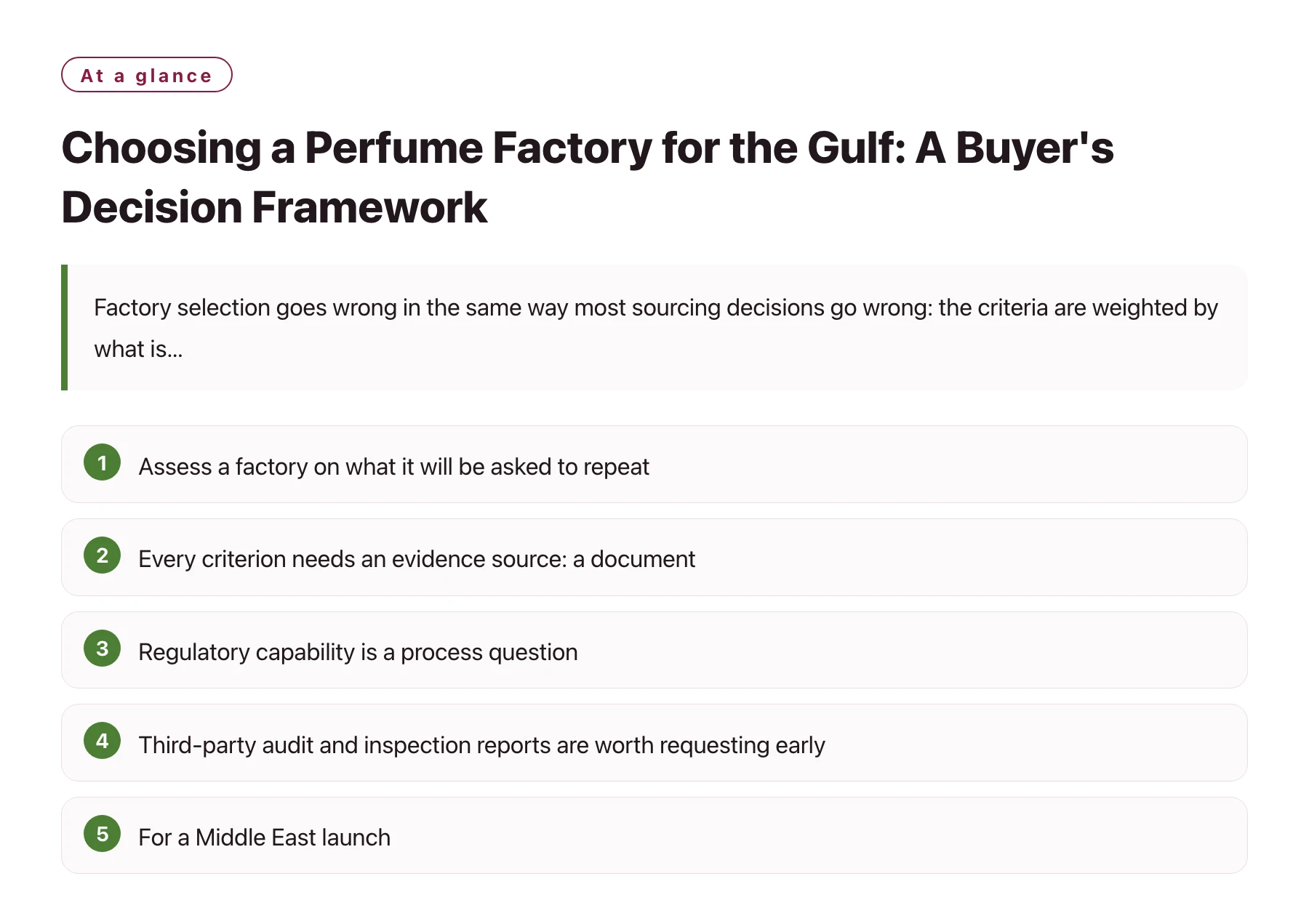
Key takeawaysAssess a factory on what it will be asked to repeat, not on the single sample it presents. · Every criterion needs an evidence source: a document, a site observation, a reference call or a test batch. · Regulatory capability is a process question, not a certificate question; IFRA maintains the standards programme that the process has to follow [1]. · Third-party audit and inspection reports are worth requesting early, because they reveal how a factory reacts to outside review [2]. · For a Middle East launch, weight packaging, presentation and transit behaviour more heavily than a temperate-climate reference suggests.
Most buyers shortlist perfume factories by collecting capability statements and comparing them. The statements are usually accurate and almost identical: development, filling, quality control, packaging, export. The differences that matter are not in the list of services but in how each service behaves under pressure.
A decision framework is simply a way of making those differences visible before signing. It replaces the question do they say they can do it with the question what would I see if they could not, and then looks for that evidence.
This framework is written for a buyer preparing a Middle East launch, where presentation standards, warm-climate performance and long transit routes shift the weighting of the usual criteria.
Start with the work the factory will actually repeat
A factory selection is not a judgement about quality in the abstract. It is a prediction about how a specific set of repeated tasks will be performed: compounding your formula, filling your format, packing your presentation, documenting your shipment. The prediction is more accurate when the criteria describe those tasks rather than the factory's overall reputation.
That is why the first step is to convert the brief into a list of repeat activities. If your line includes a refillable format, the question is how the factory verifies refill fit on every unit, not whether it can produce refillable packaging once. If your launch depends on gift presentation, the question is how decoration consistency is inspected, not whether the factory has decorated glass before.
Once the list exists, every criterion in the framework can be tied to one of its items. Criteria that cannot be tied to anything in the brief can be dropped, which is how a shortlist conversation stays short.
Why the sample is a weak signal on its own
A sample is produced under the factory's best conditions, often with direct involvement from the person who designed the formula. It tells you what the factory can do when it concentrates. It does not tell you what it does on a Tuesday morning in the middle of a run.
The useful variation is to ask how a second batch is compared against the first. A factory that answers with a retained reference, a written specification and a release test is describing a system. A factory that answers with the perfumer's judgement is describing a person, and people move between employers.
Seven criteria, the evidence to ask for, and the red flag
| Criterion | Evidence worth asking for | Red flag | Weight for a Gulf launch |
|---|---|---|---|
| Development capability | Two or three directions inside your cost and wear targets, with a written explanation of the choices | A single polished submission with no alternatives and no reasoning | High |
| Specification discipline | A sample specification showing compound code, concentrate load, carrier and retained reference procedure | Specifications written in adjectives with no numbers and no retained sample | High |
| Fill and packing control | A batch record sample, fill weight verification method and an agreed sampling plan across the run | Fill weight confirmed by visual check only | High |
| Regulatory process | A named owner for restricted materials and labelling, with the documents the factory supplies and those the brand keeps | Certificates offered as the whole answer to a compliance question | Medium to high |
| Packaging sourcing | Named bottle and closure sources, decoration method, and how component delays are handled | No visibility into component lead times until after the order | High |
| Cost transparency | An itemised quote separating compound, glass, closure, carton, decoration, fill and testing | One blended price per unit with no breakdown available | Medium |
| Behaviour under review | Willingness to accept a third-party inspection and to explain a past deviation | Reluctance to discuss anything that went wrong | Medium |
The weights are a starting point, not a verdict. A brand whose margin depends on packaging should move that row higher and accept a weaker score elsewhere. A brand selling through a channel that audits its suppliers should move regulatory process to the top. What matters is that the weighting is decided before the shortlist, so it is not quietly adjusted to favour the factory with the best presentation.
Turning criteria into a shortlist
With criteria and weights fixed, the shortlist narrows quickly. Most factories will be strong on two or three rows and ordinary on the rest; the question is whether the ordinary rows are ones your brief can tolerate. A factory with excellent development and average packaging sourcing can work well for a scent-led launch, and poorly for a gift-set launch.
Two pieces of evidence are worth chasing in every case. The first is a specification document, because it reveals how the factory thinks about repeatability. The second is the answer to what happened on a project that did not go to plan. The second question is uncomfortable to ask and produces the most information of any question in the process.
Site visits are valuable but should be timed to test something specific. A visit after the shortlist is built can confirm fill-line practice, storage conditions and whether the retained reference store is real. A visit before the criteria are written usually produces a pleasant afternoon and a favourable impression that is hard to convert into a decision.
What changes when the destination is the Gulf
Three rows deserve extra weight for a Middle East launch. Presentation is one: gift packaging and finish quality carry more commercial weight in Gulf fragrance retail, so packaging sourcing moves up. Transit behaviour is another: heat and humidity exposure during shipping and storage makes the decoration specification and the storage note more important than they would be for a short domestic route.
The third is market experience rather than market knowledge. A factory does not need to be based in the region, but it should have handled the documentation and packaging expectations of the destination before. That is best verified through a reference call, not through a capability claim.
When comparing manufacturers, background is part of the evidence but not a substitute for it. A house with a long history, such as a Chinese fragrance manufacturer since 1994, is worth checking on the same rows as any other candidate. Longevity suggests survival, not fit.
Where cost fits without dominating
Cost belongs in the framework as transparency rather than as a single number, because the number is only meaningful once the scope is identical across candidates. Comparing quotes with different packaging inclusions and different testing scopes produces a ranking that has nothing to do with price.
The rows most likely to explain an apparent price gap are decoration, testing and fill. Reading cost drivers in custom fragrance wholesale before the quote comparison is a reasonable habit, because it puts the comparison on a consistent basis rather than on the headline figure each factory chooses to lead with.
A shortlist that survives contact with a factory visit is usually one where the buyer wrote the criteria first and the evidence second. If the criteria are written after the visits, the visit that went best becomes the framework, and the decision is made on hospitality. Write the table, weight it, then go and look.
The three questions that separate similar factories
After the framework has done its work, the remaining candidates usually look alike on paper. Three questions separate them, and all three are about behaviour rather than capability.
First: who signs off a deviation, and how quickly can they do it? A factory that needs a committee to approve a fifty-unit shortfall on a component will slow every launch. Second: how will you tell me that a batch differs from the reference, and what happens next? The answer describes the communication culture the brand will live inside for the length of the relationship. Third: what is the smallest change that would make you ask for more time? The answer reveals where the real constraint sits, which is often not the process the factory leads with.
None of these questions can be answered with a certificate. Between them they predict more about a first order than any brochure, and any established factory will have a considered answer, because it has been asked before. They are also a fair test to run against Xuelei or any other candidate on the shortlist, and the answers are worth writing down in the same document as the rest of the evidence.
Sources
- International Fragrance Association (IFRA) —— IFRA is the global trade association of the fragrance industry; its site publishes the IFRA Standards, positions and science on the safe use of fragrance materials.
- SGS: Cosmetics, Personal Care & Household Testing —— Testing, inspection and certification services for cosmetics and personal care, including microbiological, stability and safety testing aligned with cosmetics GMP.
Frequently asked questions
Should a brand choose a factory close to its market?
Proximity helps with visits, freight time and last-minute changes, but it does not determine capability. For many brands the deciding factors are format experience, packaging sourcing and documentation quality, which can be found at a distance. The practical compromise is a factory that is straightforward to audit and communicate with.
How many factories should be shortlisted?
Three is usually enough for a first comparison and short enough to keep the evidence process disciplined. More candidates tend to dilute the criteria rather than improve the choice.
Are certificates enough to establish a factory's quality capability?
Certificates confirm that a system has been assessed, not how a specific batch will be made. They belong in the framework as supporting evidence. The questions that matter more are how a specification is held, how fill weight is verified and how a deviation is reported.
Is a third-party inspection worth the cost on a first order?
It is often worth it when the buyer cannot visit, and it has a second benefit: it shows how the factory behaves under outside review. Asking early also reveals whether the inspection cost has been considered in the quote.
What is the most common mistake in factory selection?
Choosing the criteria after the visits. The factory with the best presentation usually wins a comparison made on impression. A weighted framework written in advance keeps the decision anchored to the brief, especially when the destination market demands something the visits cannot demonstrate.