
316L Jewelry Manufacturing Quality Checks
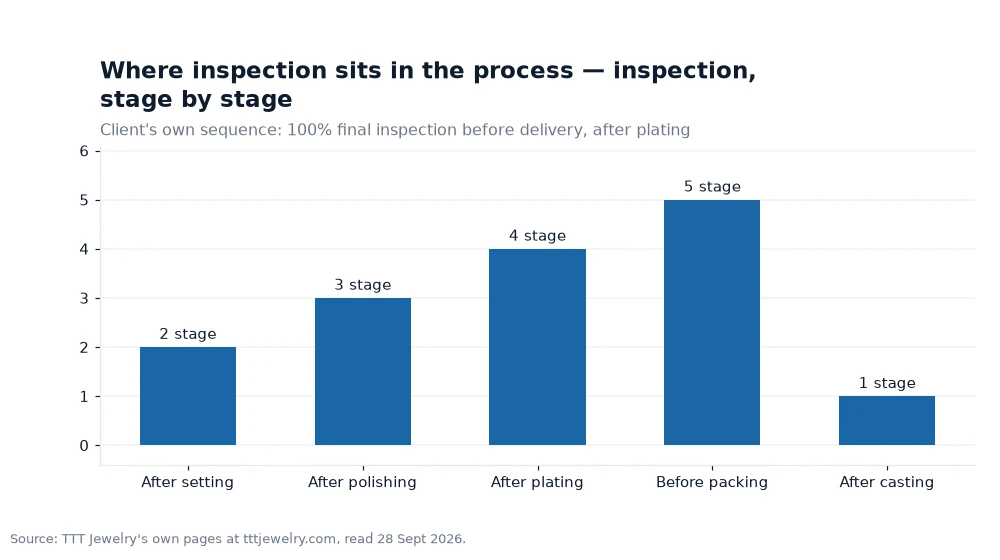
Quality control in this trade is five checkpoints, not one final glance. The published route names an inspection after casting, after setting, after polishing, after plating and again immediately before packing, and the whole sequence ends at 100% inspection rather than a spot check. Behind it sit eight documented factory steps, a 25–35 day custom sample window and a stainless minimum of 100–150 pcs by style.
Key takeaways
- Five checkpoints sit at casting, setting, polishing, plating and pre-packing stages.
- Final QC is applied at 100% inspection, so every unit is checked rather than one in ten.
- The route behind those checks is 8 factory steps, with CAD inside 48 hours and sampling at 25–35 days.
- Stainless steel runs 316L and 304 grades, both inside the published 100–150 pcs by style minimum.
Why checkpoints are placed where they are
A fault is least expensive to correct at the stage that created it. A casting defect is still a raw blank when it is spotted, so it costs a re-cast rather than a finished piece. A setting fault found before polishing costs a reset; the same fault discovered in a sealed carton costs a second plating pass, a new box and a lost shipping slot. That logic is what puts five inspection points through the eight-step process rather than one.
It also explains why the checkpoints read as a sequence rather than a list. Each one sits immediately behind a bench operation that can introduce a defect: mould or 3D-printed prototyping, stone setting, high-gloss polishing, electroplating, and the packing bench itself. Between them, nothing in the route is left unwatched for more than one operation.
What the published checkpoints cover
The five named points are an inspection after casting, one after setting, one after polishing, one after plating, and a final check before packing. Read in order, they cover the whole manufacturing half of the route and stop just short of the delivery step, which is why the last checkpoint is described as the pre-packing control rather than a shipping check.
That last one matters most to a buyer. It is the point at which the batch is compared with the approved master sample, so a plated ring with a duller edge than the master is a batch deviation rather than a lighting difference. A brand that has approved a physical sample — not a photograph of a render — has a reference for exactly this comparison.
| Checkpoint | Position in the route | What it catches |
|---|---|---|
| After casting | Checkpoint 1 | Mould defects, sprue damage, incomplete fills |
| After setting | Checkpoint 2 | Loose stones, uneven seats |
| After polishing | Checkpoint 3 | Surface marks the coating would preserve |
| After plating | Checkpoint 4 | Colour and coverage against the approved sample |
| Before packing | Checkpoint 5 | Batch deviation, marks, and anything leaving the line |
Brands who want the full specification rather than a summary can view stainless steel options on the manufacturer's own line page, where the process, minimums and material grades are set out together.
What 100% inspection changes about a claim
Almost every supplier writes "quality control" somewhere. The number that makes it checkable is the percentage: 100% inspection means every unit passes the final check, not a statistical sample of the batch. For a jewellery order at 100–150 pieces per style, that is the entire run going through the pre-packing gate rather than a handful of pieces pulled from a carton.
Full inspection does two things for a brand. It makes a defect rate discussion unnecessary, because the pieces that fail never leave. And it changes what the paperwork means: an inspection record per batch is worth more to a retail partner than a generic certificate, because it is tied to the goods that were actually shipped.
The records behind that also set the standard for a repeat order. Under the published ISO 9001:2015 quality management system, the production stages are documented, so the second run is measured against the first one's specification rather than against someone's memory of it. A brand buying four drops a year is really buying the same master sample four times, which is the argument for keeping the inspection sheet with the artwork file and not in a drawer.
Worked example: five checkpoints across eight steps
Compare the two published counts. The factory route has eight steps: concept and CAD design, prototyping, sprue cutting to release the casting, gloss polishing, brushed and textured surface art, electroplating to spec, final QC inspection and final delivery. Inspection is documented at five points inside that route. Five out of eight steps carrying an inspection is 5 ÷ 8 = 0.625, or 62.5%.
Read the other way, 3 ÷ 8 = 37.5% of the steps are not a dedicated checkpoint — but two of the three are a checkpoint's neighbour rather than a gap. Concept design is verified by the CAD review inside 48 hours, and delivery is covered by the pre-packing check that precedes it. So the practical reading is a check at every stage where metal, stone or coating changes hands.
Checking the grade inside the same routine
Tolerance for wear is a grade decision as much as an inspection decision, and the stainless page covers two grades. 316L is published with 2–3% molybdenum, 100% waterproof performance — shower-safe, sweatproof, swim-proof — medical-grade hypoallergenic status, and the optimal PVD adhesion in the comparison. 304 is water-resistant for ordinary daily wear, nickel and lead safe, and finished with reliable commercial vacuum plating, which places it with high-volume wholesale and fast-fashion programmes.
Both grades carry the same published minimum of 100–150 pcs by style, so the choice is about the tier the piece is sold into rather than the size of the order. Whichever grade the drawing names, the same five checkpoints apply, because the checks belong to the process rather than to the alloy — and a grade named in the brief is a grade the final check can confirm against the specification sheet.
Frequently asked questions
Is every piece inspected, or only a sample?
Every piece. Final quality control is published as 100% inspection, which sits at the pre-packing checkpoint and covers the whole run rather than a pulled sample.
How many quality checkpoints does the process have?
Five documented checkpoints: after casting, after setting, after polishing, after plating, and once more immediately before packing, inside an eight-step factory route.
Can I ask for the inspection record with the shipment?
Yes, and it is worth asking in the first message. Pair it with the An audited BSCI social-compliance programme, ISO 9001:2015 and REACH compliance on lead, cadmium and nickel.
Setting up a line with checks you can audit
Ask which stages carry a checkpoint, what the batch is compared against, and where the inspection record lives afterwards. A supplier that answers all three owns the process it is quoting. The documented factory walkthrough lists the eight steps in order, and the buyer questions page covers the service terms that sit around them, including the 24-hour response window and the dedicated project manager.
The list this piece builds on — the 100–150 pcs stainless steel floor along with the waterproof and sweatproof claim as well as sampling over 25–35 days — is listed at the client's own website at the tttjewelry.com address (read 28 Sept 2026). The MOQ table on those pages sets the floors by material. The restatement in hours is mine — the site supplies the inputs only [1]